



In the selection of home decoration materials, environmental protection and health have become the primary considerations for consumers. In recent years, SPC (Stone Plastic Composite) flooring has rapidly gained popularity due to its labels of "zero formaldehyde," "waterproof," and "fire-resistant." However, amidst the myriad of concepts in the market, just how environmentally friendly is SPC flooring? Is it a truly green building material, or just marketing hype? This article will provide an in-depth analysis of the environmental truth of SPC flooring through national testing standards, international authoritative certifications, and corporate environmental declaration data.

I. Core Advantage: Eliminating Formaldehyde and Heavy Metals at the Source
To evaluate the environmental friendliness of flooring, one must first look at its raw materials. Traditional wooden flooring mostly uses density board or plywood, which necessitates the use of urea-formaldehyde resin adhesives during production – the primary source of formaldehyde. The raw material composition of SPC flooring is fundamentally different.
The main raw materials of SPC flooring arepolyvinyl chloride resin and natural stone powder (calcium carbonate). This material characteristic determines its upper limit of environmental performance. The Chinese national standard GB/T 34440-2017 "Rigid polyvinyl chloride flooring" sets clear mandatory limits on hazardous substances in SPC flooring.
Taking the SPC product line of the globally leading resilient flooring manufacturer,Armstrong Flooring, as an example, its publicly available technical parameters show:
Formaldehyde Emission: ND (Not Detected) (Test method based on ISO 16000, with a detection limit below 0.005 mg/m³)
Total Volatile Organic Compounds (TVOC): <0.05 mg/m³ (Far exceeding the requirements of the national "Green Building Evaluation Standard")
Soluble Heavy Metals (Lead, Cadmium, etc.): ND (Not Detected) (Compliant with CNS 15468 standard)
Furthermore, third-party test reports for SPC flooring products from South Korea'sLG Hausys (such as the ZI:STELLA series) also clearly indicate that formaldehyde, benzene, toluene, xylene, and radioactivity are all "not detected" . This means that high-quality SPC products are indeed free from wood-based substrates at the raw material level, fundamentally eliminating the source of formaldehyde release.
II. The Plasticizer Issue: Strict Control of Phthalates
The poor environmental impression the public has of early PVC flooring mainly stems from the plasticizers and stabilizers that might have been added. Heavy metal stabilizers like lead and cadmium found in inferior materials, and phthalate plasticizers which can disrupt the human endocrine system, are key industry concerns.
Addressing this pain point, international first-tier brands have long completed technological upgrades. TakingFrance's Gerflor as an example, its SPC flooring products are explicitly labeled "Phthalate-free" and use safer, more environmentally friendly plasticizer systems. Its products have obtained the French VOC label A+ certification, which requires TVOC emission concentrations to be below 1000 µg/m³ and imposes strict limits on over 20 hazardous substances including formaldehyde and acetaldehyde.

In the Chinese market, national standards are equally stringent. Public data fromdomestic leading flooring companies (such as Kentier and Power Dekor) shows that the sum of phthalates (e.g., DEHP, DBP, BBP) in their SPC products is ≤ 0.05%, far lower than the national standard limit of ≤ 0.1% , with some products even achieving a "not detected" level.
This demonstrates that although SPC is a type of PVC material, through formula optimization, it can absolutely achieve a safe state of being"heavy metal stabilizer-free and phthalate-free."
III. Life Cycle Perspective: Carbon Footprint and Recycling Value
Environmental protection is not only about indoor air quality but also involves the impact on the environment throughout the entire process from production and use to disposal.
According to theEnvironmental Product Declaration (EPD) data published by France's Tarkett Group, its SPC flooring products utilize a significant amount of recycled materials during the raw material stage (with recycled content in some products reaching 20%-40%), significantly reducing reliance on primary fossil resources. At the end of the product's life, through material recycling and reuse mechanisms, a substantial resource compensation potential can be realized, with the environmental impact showing a negative value – representing an environmental benefit .
SPC flooring incorporates a large amount of stone powder (calcium carbonate) during production and is characterized by its100% recyclability. Its glue-free installation (click-lock design) method effectively reduces VOC pollution from adhesives during construction, truly achieving "liveable immediately after installation" without the need for air ventilation.
IV. Authoritative Certifications: Dual Recognition from International and Domestic Bodies
The most direct way to judge the environmental performance of SPC flooring is through third-party authoritative certifications. In addition to domestic standards likeGB/T 34440-2017 and the China Environmental Labeling Certification, mainstream international certifications also provide multiple endorsements for the environmental friendliness of SPC flooring.
FloorScore Certification (North American/International Standard): This is one of the most credible indoor air quality certifications in the global resilient flooring sector. SPC products with this certification must pass stringent volatile organic compound emission tests, ensuring the product has no adverse impact on air quality during indoor use. Numerous leading brands like USA's Mannington Mills hold this certification .
EU CE Certification and REACH Regulation: The CE mark is a mandatory certification for products entering the European market, indicating compliance with basic health, safety, and environmental requirements. Passing testing according to the REACH (Registration, Evaluation, Authorisation and Restriction of Chemicals) Regulation means the product does not contain over 200 Substances of Very High Concern.
French VOC Label A+: This is a mandatory environmental label for indoor building materials in France, requiring testing for TVOC and specific hazardous substances 28 days after product installation, with A+ being the highest standsard. Many SPC products from France's Gerflor and Italy's IVC Group meet this standard .
Fire Performance and Smoke Toxicity: Regarding fire safety, due to their high inorganic filler content, SPC floors are inherently non-combustible and effectively flame-retardant. Their fire resistance rating can reach Class B1 (Difficult-to-ignite materials) , complying with the GB 8624-2012 standard.
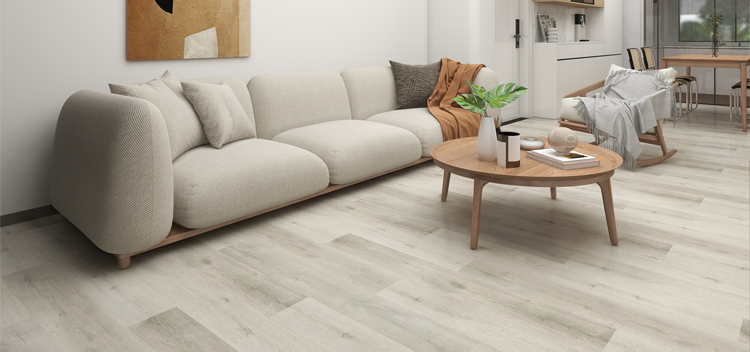
In summary, the environmental friendliness of SPC flooring stands up to data scrutiny.
Regarding "Air Safety": The formaldehyde emission from high-quality SPC products is consistently "not detected," and TVOC emission levels are far below the strictest international standards, posing no burden on indoor air quality.
Regarding "Material Safety": Leading brands have fully transitioned to being phthalate-free and heavy metal-free, eliminating the "silent killers" in decoration pollution.
Regarding "Ecological Contribution": Their recyclability and the use of recycled materials during production align with the life cycle philosophy of green building materials.
Of course, consumers must also be discerning when purchasing. The environmental friendliness of SPC flooring is not "automatic" but depends on the manufacturer's formula and process. Truly eco-friendly SPC flooring should be willing to provide test reports issued by laboratories withCMA/CNAS accreditation and demonstrate their attainment of international green certifications such as FloorScore, French A+, and GREENGUARD Gold . Only then can those rows of cold data translate into the warm and reassuring protection beneath our feet.