



When selecting materials for engineering projects, you can’t rely on renderings alone – you need real performance data. What gives eco‑flexible porcelain tile the confidence to challenge natural stone? Let’s break down its hard indicators one by one.
1. Weight: Less than one‑tenth of stone, dramatically reducing structural load
Natural stone typically requires a thickness of 15–20 mm, weighing about 50–70 kg/m². With dry‑curtain stone, the additional weight of steel frames and anchors makes the total load even more imposing. Eco‑flexible porcelain tile, in contrast, is only 1–5 mm thick and weighs just 3–8 kg/m² – roughly one‑eighth of ceramic tile.
What does this difference mean in practice? For a 30‑storey residential tower, if the entire façade uses stone, the main structure must be reinforced with extra steel and concrete. With eco‑flexible porcelain tile, no special structural treatment is required – it can be applied directly. For developers, this saves not only material costs but also structural costs. Especially during the schematic design phase, façade load is a critical parameter – the lighter the load, the less structural redundancy is needed, and the more economical the main structure becomes.
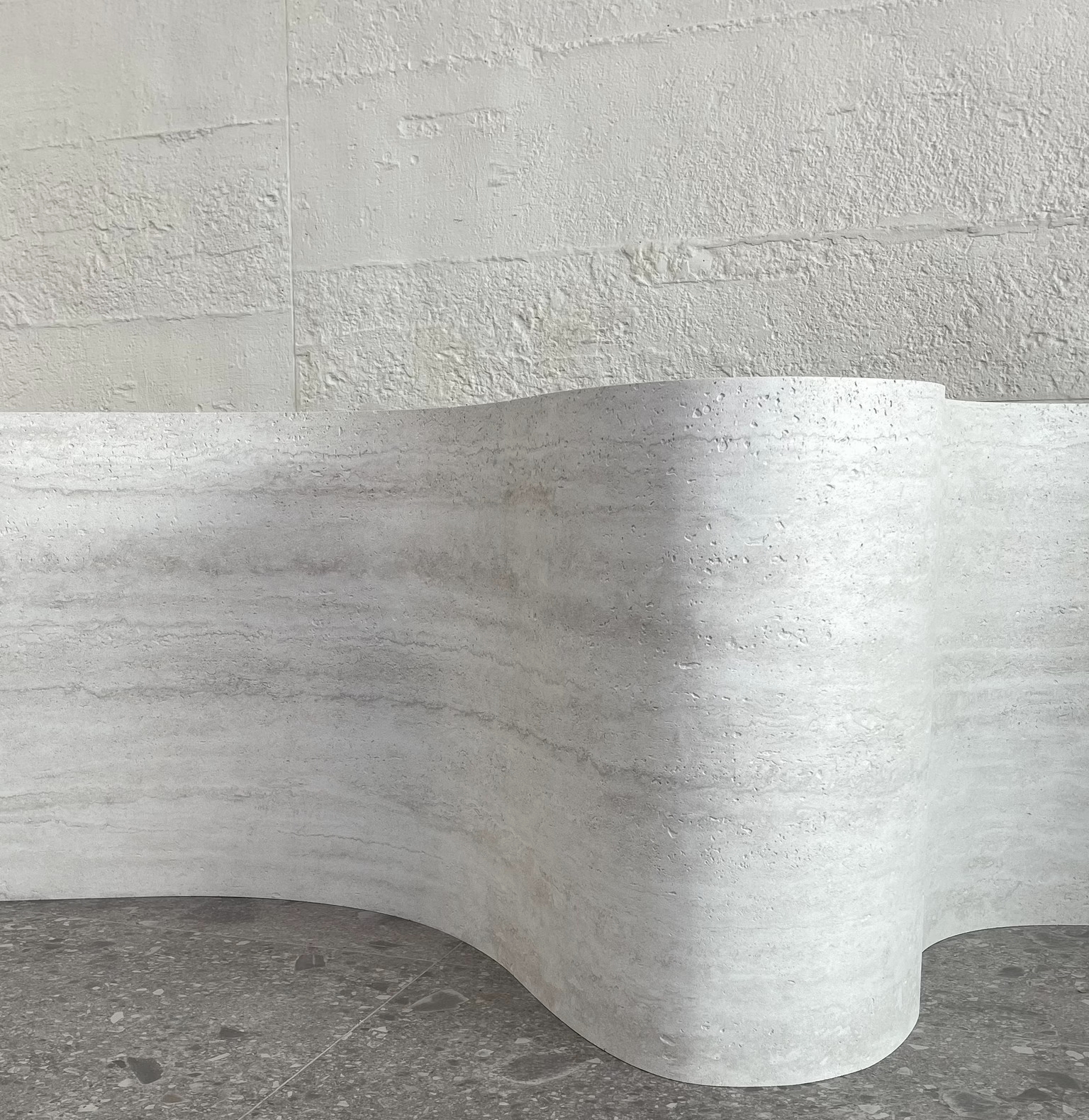
2. Flexibility: Bendable and foldable, perfect for curved and irregular surfaces
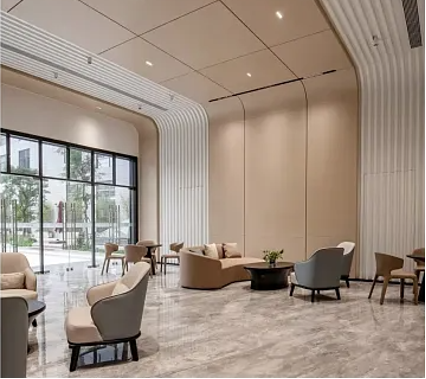
What do you do with stone on curved surfaces? You have to cut it into small pieces, which means more joints, higher costs, and compromised aesthetics. Eco‑flexible porcelain tile is different – it offers excellent flexibility, with a minimum bending diameter of less than 100 mm, allowing it to conform easily to columns, arches, domes, and other complex curved shapes. According to technical literature from Xinzhu Mingzhu Green Materials, eco‑flexible porcelain tile achieves a “form‑following” installation effect, fundamentally eliminating the hollowing and cracking problems common with rigid materials on curved substrates.
In real projects, decorative curved surfaces have always been a major design challenge – think spiral stair sidewalls, curved balcony parapets, or circular lobby columns. Traditional stone requires factory pre‑assembly and on‑site adjustments, which is time‑consuming and labour‑intensive. Eco‑flexible porcelain tile can be cut and applied directly on‑site according to the actual curvature, even enabling seamless wrap‑around coverage, greatly enhancing design freedom.
3. Fire performance: Class A – meeting mandatory national standards
According to China’s Code for Fire Protection Design of Buildings GB50016‑2014 (2018 edition), Article 6.7.12, the exterior decorative layer of buildings must use Class A materials, except that Class B1 materials are permitted when the building height is no more than 50 m. In practice, most mid‑rise and high‑rise buildings require at least B1, while high‑rise and especially super‑high‑rise buildings generally mandate Class A.
Eco‑flexible porcelain tile is made from inorganic mineral powders, which are inherently non‑combustible, achieving Class A. This is a crucial factor during fire safety inspections – it directly determines whether the material can be installed on the wall. Many exterior paints and stone‑like coatings can only achieve B1 or even B2, posing compliance risks for high‑rise façades.
4. Weather resistance: 3,500 hours of artificial ageing – equivalent to 50 years of outdoor performance without degradation
What does exterior cladding fear most? Fading, cracking, and powdering after prolonged sun, wind, and rain. Baorunda’s flexible porcelain products have passed 3,500 hours of artificial ageing – roughly six times the testing standard for stone‑like coatings. Industry data shows that eco‑flexible porcelain tile can achieve over 2,000 hours of ageing resistance, with excellent acid‑and‑alkali resistance. Even under prolonged UV exposure and frequent acid rain, the façade retains its colour stability. Some high‑end products claim over 3,500 hours of ageing resistance, equivalent to 50 years of service life.
Here’s a technical detail worth noting: the weather resistance comes from the material’s very nature – modified clay is itself a natural inorganic mineral with outstanding UV resistance and tolerance to acid/alkali/salt corrosion. After composite modification, this inorganic durability is preserved while organic flexibility is added, achieving a “rigid‑flexible synergy.” In other words, the colour and texture are not just a surface coating – they emanate from the material itself, so it won’t peel or reveal an underlying layer as coatings do.
5. Waterproof & self‑cleaning: Lotus effect – rain washes it clean
Eco‑flexible porcelain tile features a unique nano‑surface treatment that creates a lotus‑like hydrophobic effect. Rainwater beads up and rolls off, carrying dust and dirt with it, achieving self‑cleaning. Moreover, its waterproof performance is outstanding – even after 96 hours of water immersion, there is no blistering, cracking, or detachment, and it fully recovers its original strength and colour after drying. This is particularly practical for façades – property management does not need frequent cleaning, and long‑term maintenance costs are significantly reduced.
6. Freeze‑thaw resistance: 100 cycles without cracking – reliable in cold regions
In northern cold climates, exterior materials must withstand repeated freeze‑thaw cycles in winter. Ordinary coatings tend to crack and peel, but eco‑flexible porcelain tile endures 100 freeze‑thaw cycles with no visible cracking and tensile strength ≥1 MPa. This means it performs reliably from Harbin to Guangzhou, and from Turpan to Lhasa.
7. Texture fidelity: ≥98% similarity – visually indistinguishable from natural stone
Using high‑definition digital inkjet printing combined with physical embossing, eco‑flexible porcelain tile achieves a stone‑like realism of over 98%. To verify this, I visited several completed sample walls. From a distance, they looked exactly like natural stone – the layering of veins, colour transitions, and even the subtle surface undulations were highly convincing. Up close, you can feel the textured surface, but because it is a flexible material, there is a slight tactile difference – stone feels colder and harder, while the flexible tile feels slightly warmer. For the vast majority of observers, however, this difference is negligible.
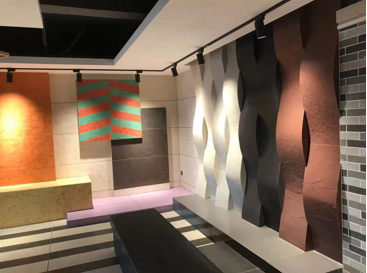
Eco‑flexible porcelain tile covers nine main series – travertine, marble, granite, slate, sandstone, rammed earth, polished stone, and chiselled stone – essentially covering all mainstream architectural stone effects. Colours for each texture can be customised. Architects can choose from standard swatch libraries just as they would with paint colour cards, or request custom blends according to design drawings.
8. Breathability: Buildings can “breathe” – moisture‑proof and mould‑proof
With its micro‑porous breathable structure, eco‑flexible porcelain tile is both waterproof and vapour‑permeable, allowing walls to breathe naturally and preventing internal dampness and mould growth. This was verified in the Foshan Museum project, where the micro‑pores acted as an “alveolar system” on the wall surface, subtly absorbing or releasing moisture in response to environmental changes – helping to stabilise indoor humidity and create a stable micro‑climate for delicate artefacts like paintings and wooden objects. For residential projects in humid southern regions, this is especially critical. Traditional dry‑curtain stone is too airtight – trapped moisture between the insulation layer and the wall can lead to condensation, insulation failure, and even mould growth over time.
9. Environmental & health safety: Zero formaldehyde, zero radiation – ready for occupancy
Made from natural inorganic minerals, eco‑flexible porcelain tile is non‑toxic, non‑radioactive, and releases zero formaldehyde. Moreover, it is fully recyclable, generating no construction waste – a truly cradle‑to‑cradle solution. This means no ventilation period is needed after installation – the building can be occupied immediately. For residential projects with fit‑out delivery, this is a real plus in customer experience: homebuyers are highly sensitive to indoor air quality, and zero‑emission wall materials become a tangible selling point during sales presentations and handover.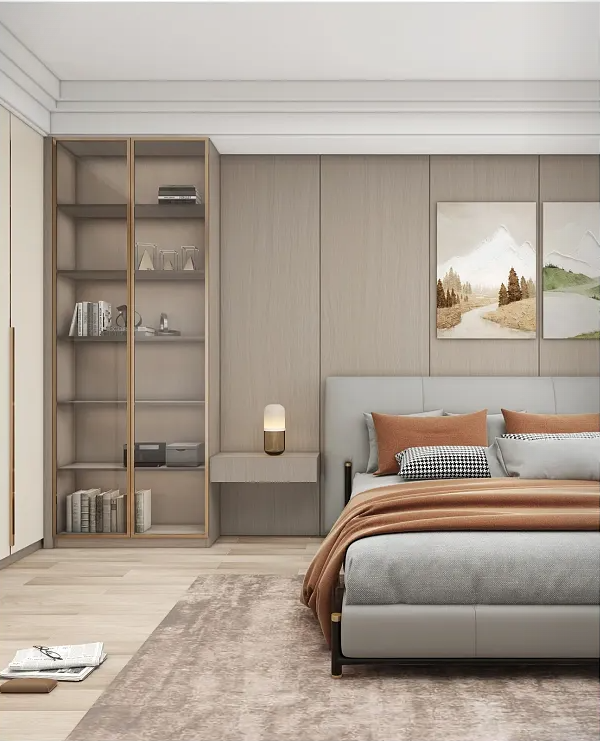
10. Safety & anti‑detachment: Light weight + strong bonding – reliable for high‑rise buildings
While traditional dry‑curtain stone has its structural safety measures, risks remain – corrosion of anchors, fatigue cracking of stone, and detachment during earthquakes. Eco‑flexible porcelain tile is extremely light and uses a dedicated polymer adhesive with high bond strength and excellent seismic performance. Even under accidental impact, it does not shatter like ceramic tile, reducing injury risk. For super‑high‑rise buildings over 100 m, façade detachment is a major safety hazard – the lightweight nature of eco‑flexible porcelain tile fundamentally reduces that risk.
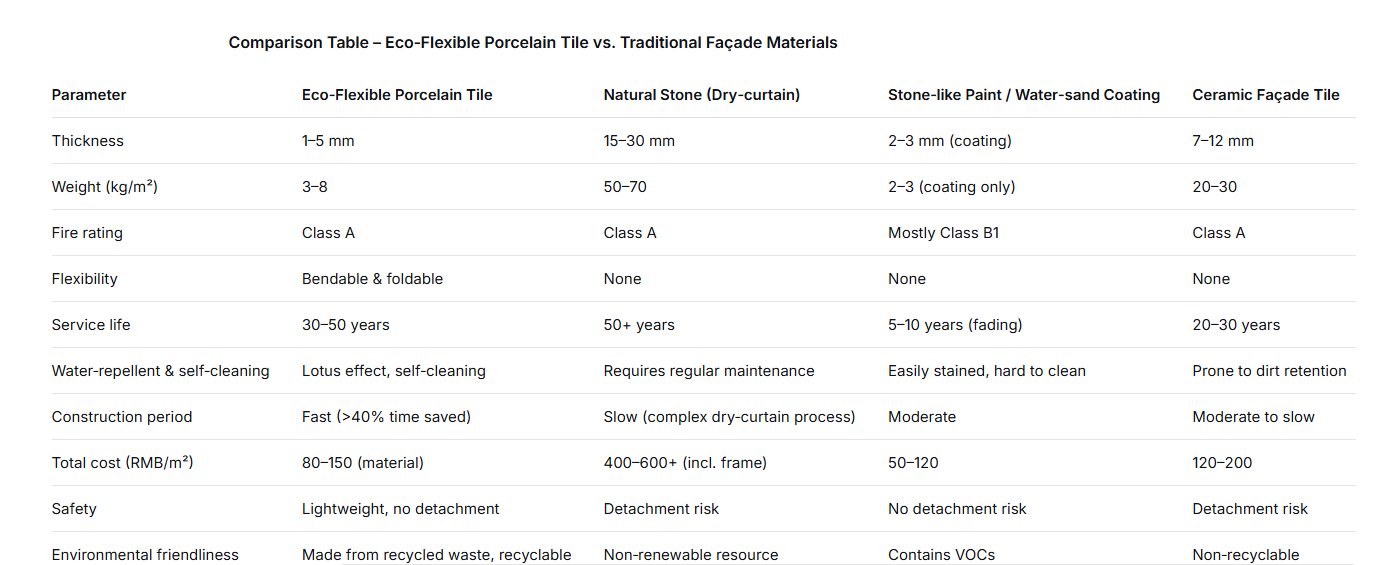
From this comparison, it is clear that eco‑flexible porcelain tile does not “dominate” every single indicator – rather, it strikes the optimal balance across the key dimensions of light weight, Class A fire rating, excellent durability, and moderate cost. In engineering terms, it is a well‑rounded all‑performer with balanced and outstanding metrics – which is precisely why its market size has grown from several billion to over ten billion yuan in just a few years.
Choose Olinmat Eco‑Flexible Porcelain Tile – Engineered for Performance, Designed for Excellence
At Olinmat, we take this technology further. Our eco‑flexible porcelain tiles are manufactured with premium modified inorganic minerals, offering all the advantages above – ultra‑lightweight, Class A fire‑rated, weatherproof, self‑cleaning, and breathable – while providing an extensive library of stone textures and custom colours to match your architectural vision. Whether you are a developer, architect, or contractor, Olinmat delivers consistent quality, fast delivery, and technical support from design to installation.
Ready to upgrade your next project?
For samples, technical data, or a tailored quotation, please contact us:
Phone: 13037926232
Email or Online Inquiry:tf88888_2023@qq.com
We look forward to partnering with you – let’s build lighter, safer, and more sustainable façades together.