


In 2026, Flexible Stone (MCM) is transitioning from a “new material” to a standard option for more and more construction projects. The global market exceeded USD 4.87 billion in 2025 and is projected to reach USD 8.23 billion by 2030, with a CAGR of 11.0%. China’s market is growing even faster, with a projected CAGR of 12.8% and output value potentially reaching RMB 23.15 billion by 2030.
Growth is driven by three factors: global urban renewal and green building policies, stricter safety controls on high-rise exterior walls limiting heavy rigid tiles, and rising demand for fast-installation materials in prefabricated and renovation projects.
I. Export Data: Middle East Is the Second-Largest Market
China‘s Flexible Stone exports entered a rapid expansion cycle in 2026. 2025 export value reached RMB 4.2 billion, up 22.7% year-on-year; 2026 is projected to reach RMB 5.1 billion.
Southeast Asia accounts for 51.3% of total export volume, with the Middle East at 29.6%. The Middle East and Africa region saw demand growth of 18.1%, the fastest globally.
Saudi Arabia’s NEOM Phase II placed a single Flexible Stone order worth RMB 130 million, setting a record for the largest single export order in the product‘s history. The 2026 cancellation of the 9% export tax rebate for traditional ceramic tiles is accelerating the shift from low-margin tiles to high-value Flexible Stone.
II. Middle East Policy Window and Supply Gap
Egypt
The 2026 building materials tariff adjustment reduced import tariffs on LEED-compliant green building materials from 20%–30% to 10%, effective January 1, 2026. Egypt’s self-sufficiency rate for green building materials is only 40%, with high-end import dependence exceeding 80%.
Saudi Arabia
Saudi Aramco‘s 2026 industrial facility tender requires dual certification—both Mostadam and LEED—making green certification an entry requirement, not a bonus.
GCC-wide
Dubai’s Al Sa‘fat, Abu Dhabi’s Estidama, and Saudi Arabia‘s Mostadam are now tied into permitting processes. EPD-backed material selection is becoming a hard threshold—suppliers without verified data are excluded at the shortlist stage.
III. Installation Key Steps
Substrate Preparation
Must be solid, flat, clean, and dry. Repair low areas with 1:3 cement mortar, max 15mm per layer. For renovations, conduct pull-off test with tensile strength ≥0.3MPa.
Layout Marking
Horizontal control lines every 3 storeys; vertical spacing ≤1.5m. Joint width 3–5mm. Full tiles at corners; cut tiles ≥100mm.
Cutting
Straight cuts with dedicated knife; irregular cuts with hand-held cutter. Cold bending for curves with minimum radius of 50mm.
Adhesive Mixing
Water:adhesive = 1:4 by weight. Mix 3–5 minutes, rest 5 minutes, remix 2 minutes. Use within 2 hours. Full-coverage method with 6mm notched trowel, thickness ~3mm, coverage ≥95%. Apply within 15 minutes.
Application
Bottom-up, left-to-right. Press gently, tap with rubber mallet from centre outward. Check flatness—correct deviations >2mm immediately. No rain or impact for 24 hours.
Joint Filling & Protection
Clean joints, fill with low-alkaline filler matching stone colour. Cover with protective film until handover.
IV. What OlinMat Can Do
Sourcing
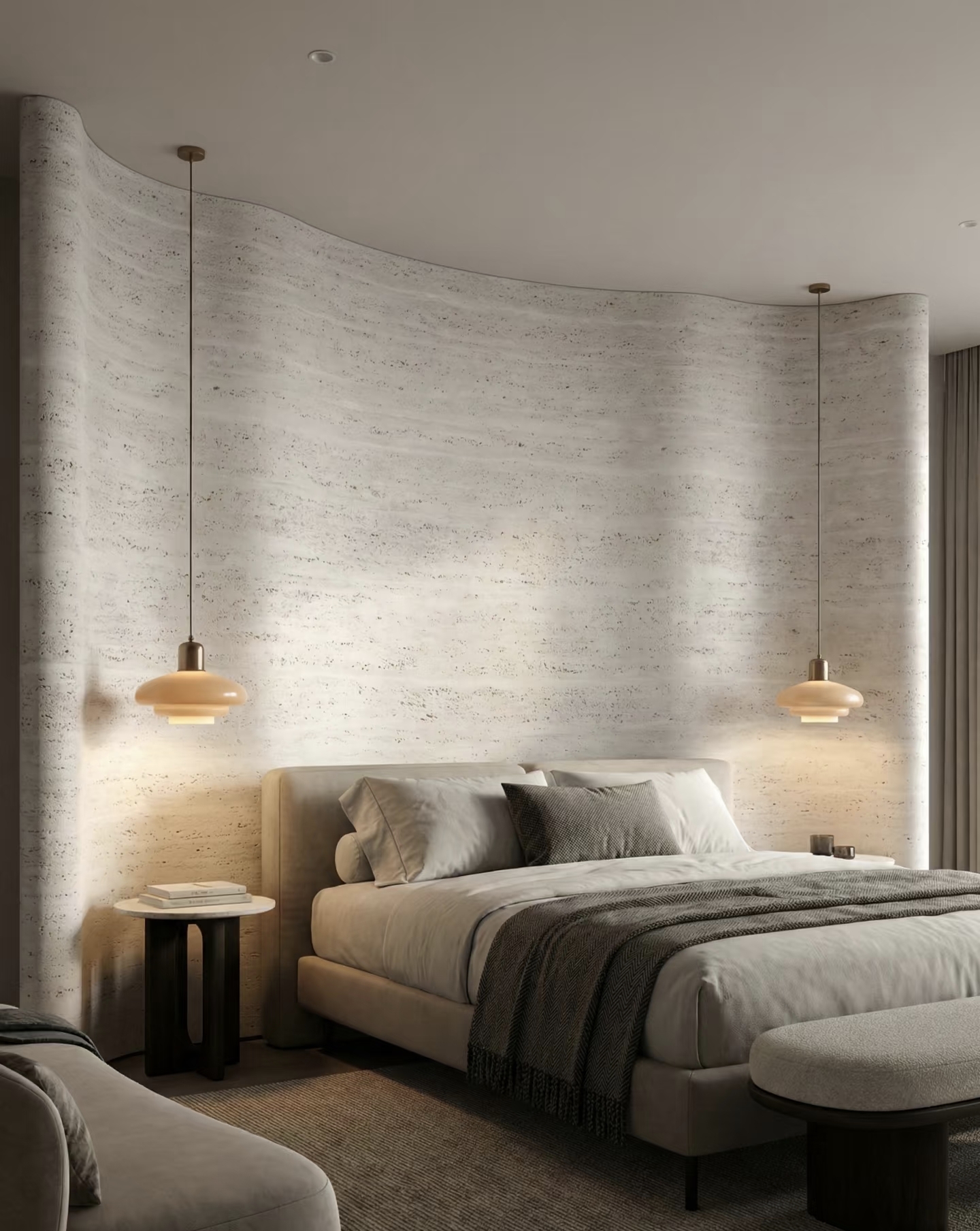
Direct from Chinese factories—Slate, Travertine, Rammed Earth, Dacite, Hemp Weave, Bamboo Weave.
Compliance
Assist with CE, REACH, SGS documentation; align with LEED, Estidama, Mostadam material scoring.
Delivery
Showroom and in-stock warehouse in Egypt—view samples, confirm specs, immediate pickup. Full-container orders coordinated end-to-end.
Installation Support
Technical guidance and adhesive recommendations.
Category Synergy
Wall stickers, LVT flooring, vinyl woven carpet, smart locks, and more.
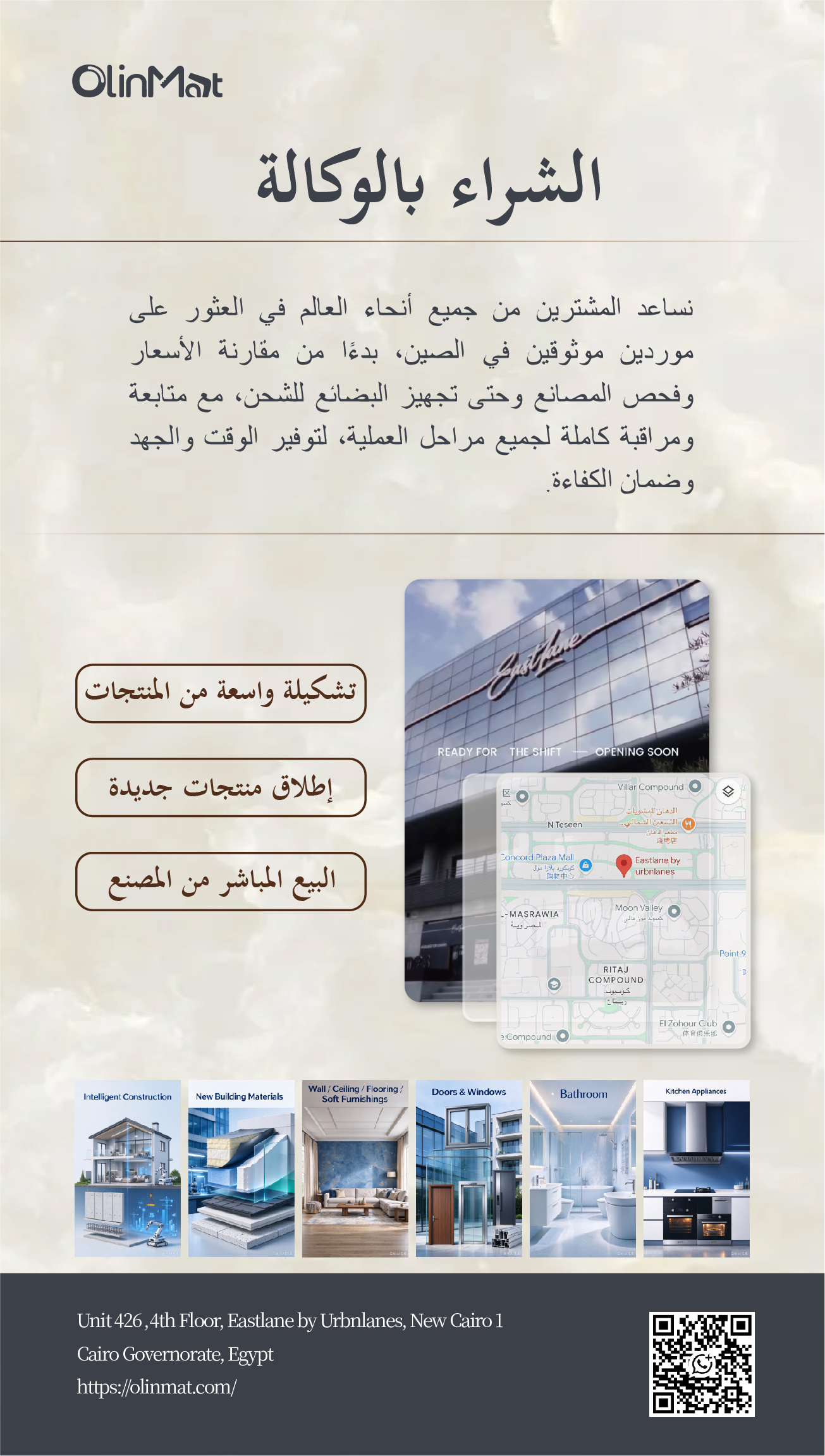
We have a showroom and in-stock warehouse in Egypt.
Building material buyers, wholesalers, project contractors, and design firms are welcome to visit.
📩 Interested in procurement cooperation? Let’s talk!
📱 WhatsApp: +8617392261224