


If you're involved in procurement for hotels, offices, or commercial spaces, you've likely encountered this scenario: the designer specifies "the texture and warmth of carpet," but the operator firmly objects—traditional carpets are not stain-resistant, hard to maintain, and prone to mould, driving up long-term maintenance costs.
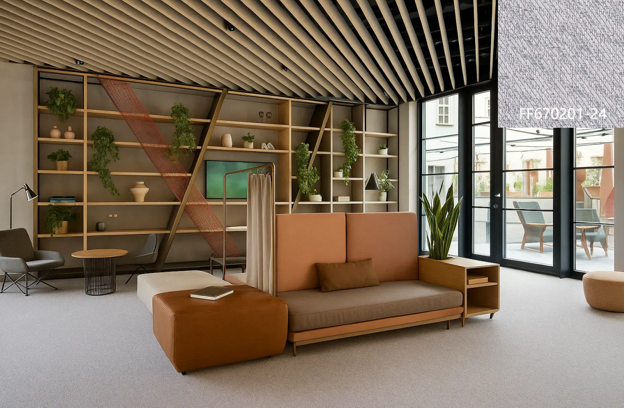
Vinyl woven carpet emerged precisely to resolve this contradiction. It uses PVC material to create a woven texture, addressing the pain points of traditional carpets while retaining the visual depth and underfoot comfort of a textile floor. But the market is uneven. Even for products all called "woven carpet," differences in material composition, weaving method, and backing structure mean significant variations in performance and suitable applications.
I. Material: Not All "Woven Carpets" Are the Same
The core raw material of vinyl woven carpet is polyvinyl chloride (PVC), but the actual product composition is more complex than the two letters "PVC" suggest.
The typical material composition of mainstream products is 93% PVC + 5% fiberglass + 2% polyester. The fiberglass provides dimensional stability, preventing post-installation shrinkage and deformation. The polyester affects the feel and elasticity of the woven yarn.
The backing structure is another key variable. There are three common backing types: PVC foam backing, which offers a softer underfoot feel suitable for spaces needing some comfort; PVC hard backing, which provides strong support for high-traffic areas; and non-woven backing with anti-slip dots, which is lighter and suitable for projects with floor load limitations.
Weight and thickness directly reflect the material quality. Standard roll products typically measure between 2.5–2.8mm in thickness and 2.7–3.1 kg/m² in total weight. Tiles (50×50cm), which usually use thicker backing, can reach 3.5–4.5mm in thickness. Products weighing below 2.5 kg/m² generally indicate reduced weave density or backing thickness—worth noting for long-term dimensional stability.
II. Weaving: The Texture Is Woven, Not Printed
This is the most fundamental difference between vinyl woven carpet and ordinary PVC flooring.
The texture of ordinary PVC flooring is a flat pattern printed on the surface. Vinyl woven carpet‘s surface layer is formed by interlacing warp and weft yarns, making the texture three-dimensional and tactile. Run your fingers across it and you feel the undulations of the weave. When light sweeps across the surface, the interlaced structure produces subtle light-and-shadow transitions.
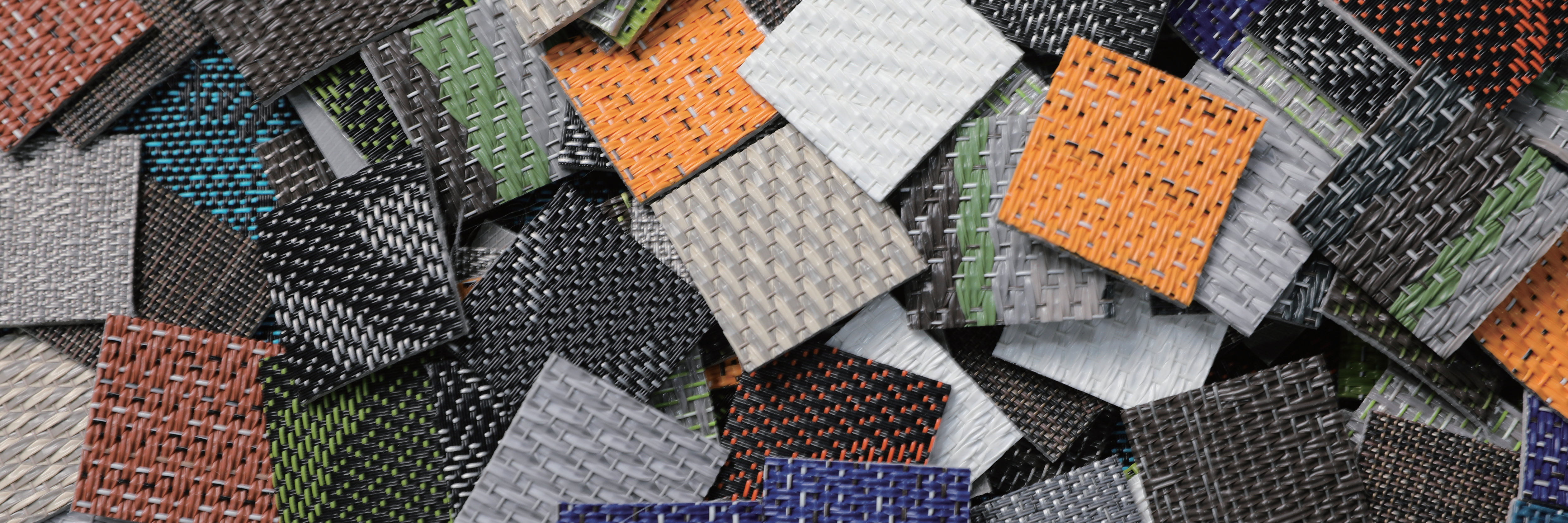
The choice of weaving method directly determines the final effect. Common weaving forms in the industry include round yarn, flat yarn, plied round yarn, flat leather, and S-shaped yarn. Round yarn weaving produces a fuller, more three-dimensional texture, suitable for scenarios where material quality needs to stand out. Flat yarn weaving creates a smoother surface with better cleaning convenience. S-shaped yarn, through its special cross-section design, delivers a finer tactile feel while maintaining the woven texture.
Based on standard industry product specifications, the range of available texture options is substantial. Round yarn weaving alone offers 27 patterns, flat yarn 19, flat leather 20, plied round yarn 9, and S-shaped yarn 34. Basic pattern shapes cover rectangles, squares, hexagons, triangles, fans, wings, and other geometric forms.
This means buyers can select the weaving solution that matches their project’s specific needs—whether it‘s a more pronounced woven grain or a flatter, easier-to-clean surface; large continuous installation or patterned design work.
III. Performance: The Parameters That Actually Matter in Procurement
Fire Rating. A hard threshold for commercial projects. European BFL-S1 is the industry mainstream, corresponding to Chinese Class B1. Self-extinguishing when the flame source is removed—an entry requirement for hotels, offices, shopping malls, and other venues subject to fire safety codes.
Dimensional Stability. This parameter determines whether the product will shrink after installation. Industry standards require ≤0.25% (ISO 2551). Products below this threshold maintain stability even in environments with significant temperature variation, without joint cracking or edge curling.
Sound Reduction. The woven structure itself provides sound absorption, with mainstream products delivering 12–14 dB of noise reduction. For meeting rooms, hotel corridors, and open-plan offices with acoustic requirements, this is a very practical indicator.
Slip Resistance. Dry slip resistance coefficient >0.3 (EN 13893), with slip resistance maintained in wet conditions. A basic safety requirement for spaces with elderly or children, as well as hotel bathroom dry areas and public corridors.
Cleaning and Maintenance. The dense surface prevents liquids from seeping between the woven fibers. Daily cleaning requires only a damp cloth, with over 98% liquid repellency. No professional carpet cleaning equipment needed—for hotels and commercial spaces, this translates into tangible savings in daily housekeeping labour costs.
IV. Applications: Where These Products Actually Fit
Hospitality projects are the most mature application scenario for vinyl woven carpet. Guest room corridors and elevator lobbies are high-frequency use areas, and the carpet’s Class 33 wear rating and sound reduction performance match the requirements precisely. Lobbies and public lounge areas need both aesthetics and durability—the three-dimensional woven texture offers more design expression than ordinary PVC flooring. Restaurant and bar areas require waterproof and stain-resistant performance—spilled wine and coffee wipe clean without leaving a mark.
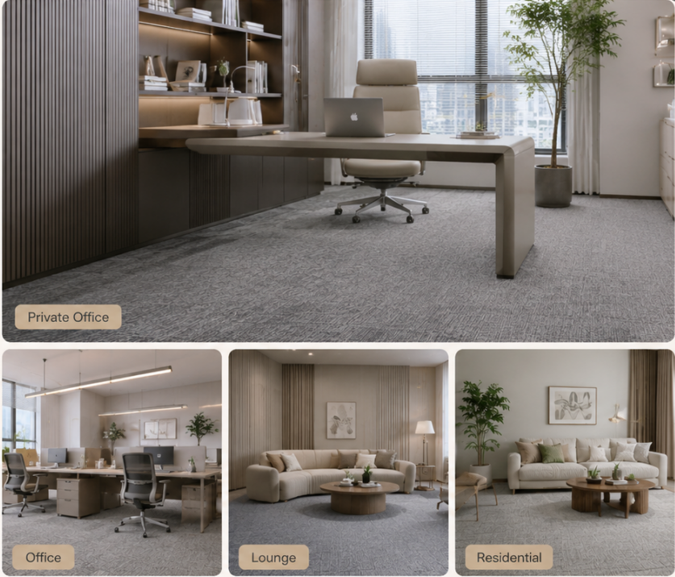
Office buildings core scenarios are meeting rooms, corridors, and open-plan workspaces. Meeting rooms need acoustic control, and woven carpet’s noise reduction far outperforms hard flooring. Corridors are high-traffic areas where PVC material’s wear resistance is far superior to traditional textile carpet. Open-plan offices need underfoot comfort and ease of cleaning—woven carpet delivers on both.
Commercial spaces—retail stores, showrooms, and boutiques—have higher requirements for flooring material quality. The inherent design appeal of the woven texture can complement the spatial tone while meeting the demands of high foot traffic.
Healthcare and educational institutions—hospitals, schools, kindergartens—have higher hygiene requirements. PVC material itself is antibacterial and mould-resistant, does not fear water, and does not harbour bacteria or dust mites. Combined with compliant fire ratings, it is a practical flooring choice for these types of public buildings.
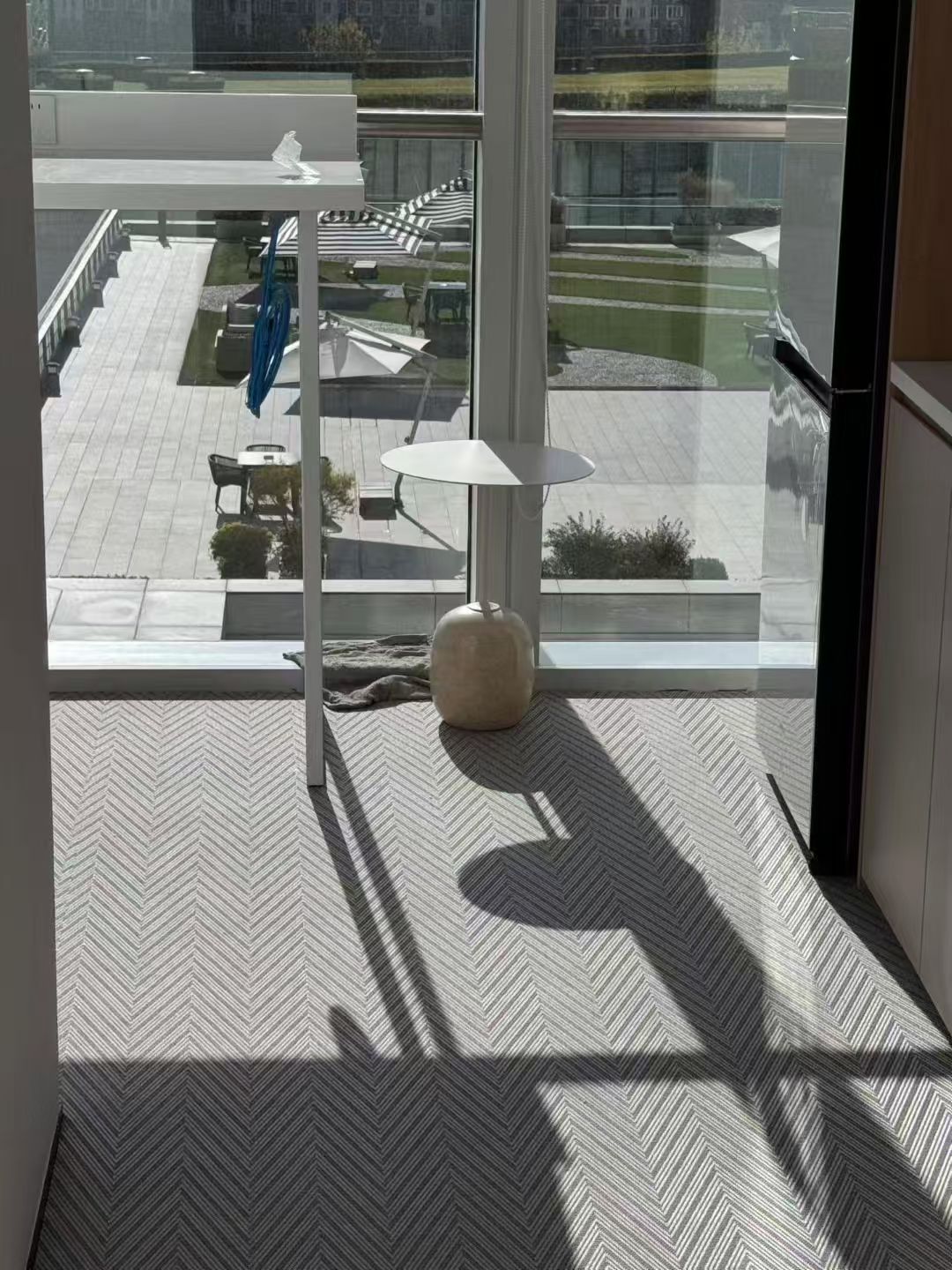
Residential spaces—living rooms, bedrooms, and studies. Compared to the coldness of ceramic tiles and the delicacy of solid wood flooring, woven carpet’s underfoot feel is more temperate and its daily care simpler. Balconies and semi-outdoor spaces are equally suitable—PVC’s waterproof performance makes it more weather-resistant than traditional carpet.